

How to Cite
Abstract
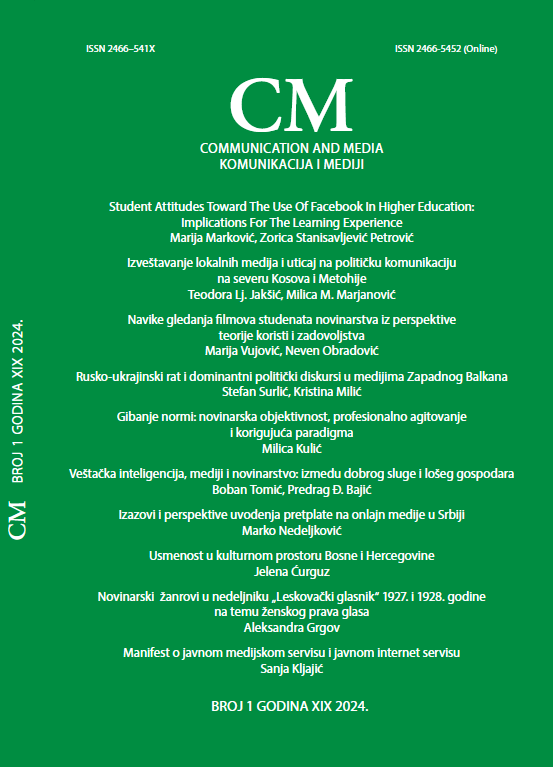
Looking at media content, especially since the beginning of the war in Ukraine in 2022 and the subsequent conflicts, it is repeatedly confirmed that basic journalistic principles are entangled in political and economic agendas. Media-dictated agendas have become the framework within which thinking is constrained. Public opinions are confined within existing agendas, further restricted by new media iron curtain. The media, captured not only by individual political and economic interests of the government or owners but also by the necessary global worldview to which the government belongs, are restrained. Journalists seem to be expected not to be objective but engaged, fueling ideological frameworks and refraining from questioning their own policies, thus reinforcing the fortress of ideological extremism where media and their owners sit. Therefore, this theoretical work will examine changes in the journalistic profession by questioning objectivity in the context of a paradigm repair. It will attempt to establish whether the journalistic profession requires new definitions or can exist within its traditional professional framework. Additionally, it will try to determine whether the process of media capture is a legitimization of the existing state or a propaganda context of the era that professional journalism can address.
Keywords
Copyright
Authors retain copyright of the published papers and grant to the publisher the non-exclusive right to publish the article, to be cited as its original publisher in case of reuse, and to distribute it in all forms and media.
Licensing
The published articles will be distributed under the Creative Commons Attribution ShareAlike 4.0 International license (CC BY-SA). It is allowed to copy and redistribute the material in any medium or format, and remix, transform, and build upon it for any purpose, even commercially, as long as appropriate credit is given to the original author(s), a link to the license is provided, it is indicated if changes were made and the new work is distributed under the same license as the original.
Users are required to provide full bibliographic description of the original publication (authors, article title, journal title, volume, issue, pages), as well as its DOI code. In electronic publishing, users are also required to link the content with both the original article published in CM: Communication and Media and the licence used.
Authors are able to enter into separate, additional contractual arrangements for the non-exclusive distribution of the journal's published version of the work (e.g., post it to an institutional repository or publish it in a book), with an acknowledgement of its initial publication in this journal.
Self-archiving policy
Authors are permitted to deposit author’s publisher's version (PDF) of their work in an institutional repository, subject-based repository, author's personal website (including social networking sites, such as ResearchGate, Academia.edu, etc.), at any time after publication.
Full bibliographic information (authors, article title, journal title, volume, issue, pages) about the original publication must be provided and links must be made to the article's DOI and the license.
Disclaimer
The views expressed in the published works do not express the views of the Editors and the Editorial Staff. The authors take legal and moral responsibility for the ideas expressed in the articles. Publisher shall have no liability in the event of issuance of any claims for damages. The Publisher will not be held legally responsible should there be any claims for compensation.