

Najnoviji broj
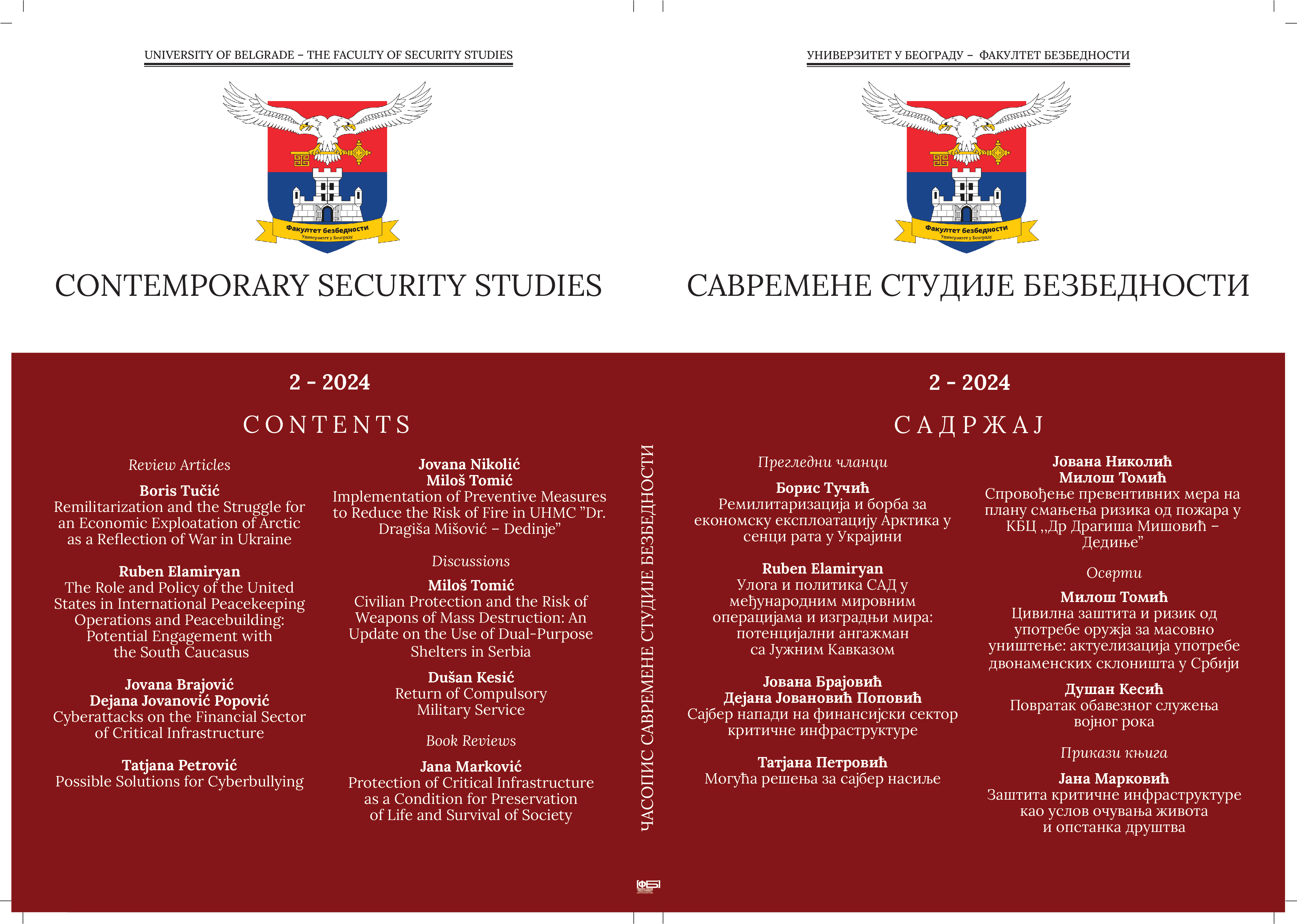
The International Journal of Contemporary Security Studies (IJCSS) is a double-blind peer-reviewed, open-access, international journal published twice a year. The journal serves as a platform for academics, policymakers, and practitioners to share high-quality research and practical insights on contemporary security issues.
IJCSS explores a broad range of security topics, including but not limited to national security, cyber security, intelligence studies, counterterrorism, organized crime, geopolitical conflicts, hybrid threats, military strategy, crisis and emergency management, critical infrastructure protection, radicalization, border security, international relations, environmental security, fire safety, disaster risk reduction, nuclear, biological, and chemical security threats, transnational organized crime, migration and border control, space security, human security, public safety, and security governance. The journal also examines the intersection of technology, human rights, and security policy in an evolving global landscape.
Aims and Scope
The journal aims to provide an interdisciplinary platform for theoretical and empirical research in security studies. It seeks to facilitate communication between academics, security practitioners, policymakers, and analysts, encouraging a deeper understanding of security challenges in a rapidly changing global environment. The International Journal of Contemporary Security Studies (IJCSS) explores a broad range of security-related topics, covering both traditional and emerging security challenges. These include, but are not limited to:
- National security and defense policies
- Cyber security, digital warfare, and information security
- Intelligence studies, surveillance, and strategic analysis
- Counterterrorism, violent extremism, and deradicalization strategies
- Transnational organized crime, human trafficking, and illicit networks
- Geopolitical conflicts, hybrid warfare, and asymmetric threats
- Military strategy, defense technologies, and arms control
- Crisis and emergency management, disaster risk reduction, and humanitarian response
- Critical infrastructure protection and resilience planning
- Environmental security, climate change, and resource conflicts
- Fire safety, risk assessment, and emergency response strategies
- Nuclear, biological, and chemical security threats
- Border security, migration policies, and cross-border crime
- Public safety, urban security, and law enforcement strategies
- Human security, human rights protection, and ethical challenges in security studies
- Security governance, policy-making, and legal frameworks
- Space security and emerging threats in outer space operations
IJCSS aims to provide a multidisciplinary platform that facilitates dialogue between academics, practitioners, policymakers, and analysts to enhance global security, stability, and resilience in an increasingly complex and interconnected world. The journal promotes collaboration between different disciplines to develop comprehensive security solutions and enhance global stability and resilience.
Editor-in-Chief
Prof. Dr. Vladimir M. Cvetković
University of Belgrade, Faculty of Security Studies, Belgrade, Serbia.