

How to Cite
Abstract
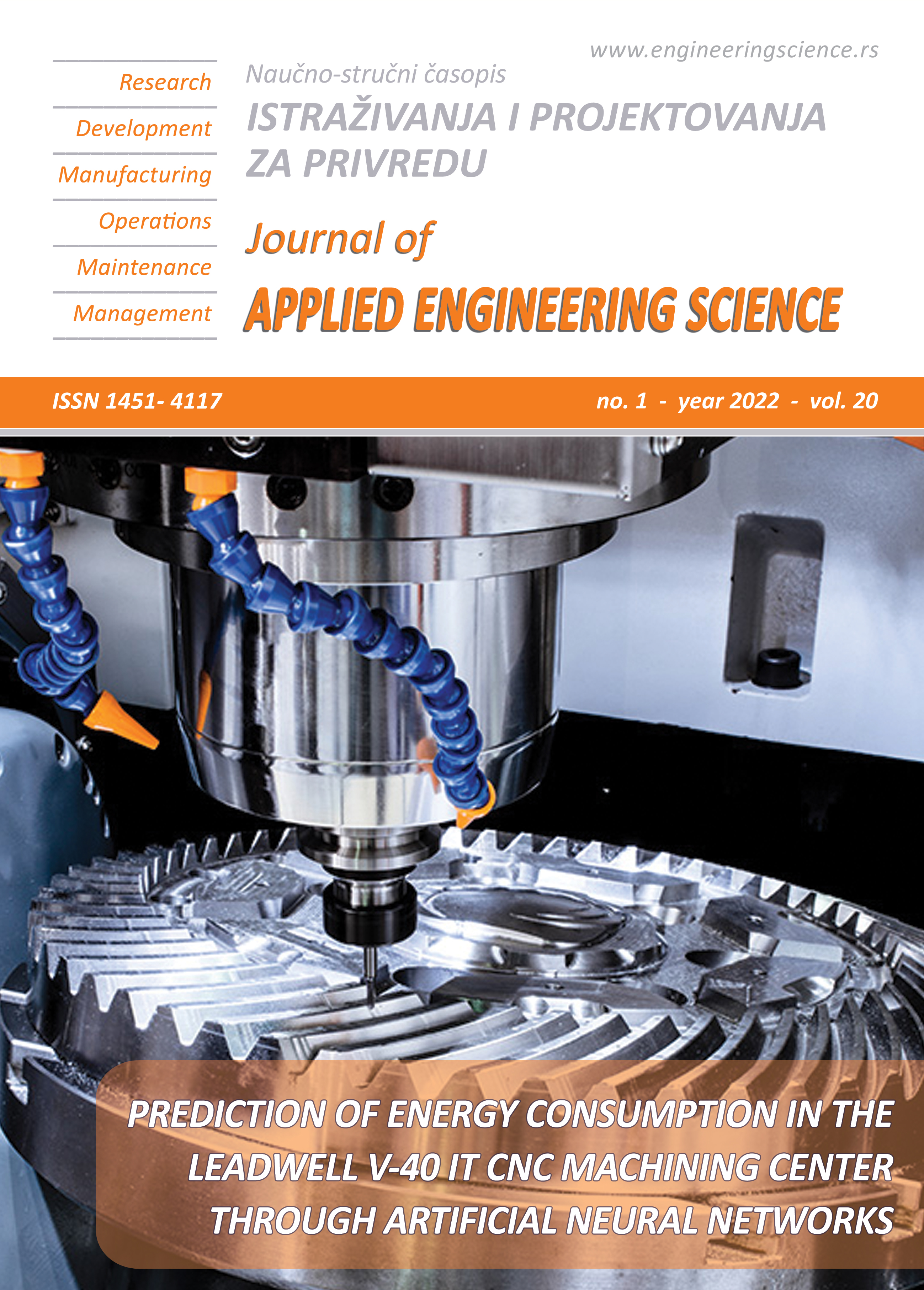
The modern machining industry faces reducing manufacturing cost pressure and improve product quality expectations. Due to this competition a manufacturer must continually identify cost cutting opportunities in manufacturing process. The keys technology represents cost-saving opportunities associated with reducing cutting fluid consumption, cutting energy consumption, and improves the overall performance of machining operations at the same time. Hence, multiple response optimization techniques have recently become the focus of research to improve product quality by increasing surface quality and reduce costs by reducing cutting force, cutting fluids, and energy consumption of the cutting process recently. Among various optimization methods, few Taguchi-based likes as TOPSIS, COPRAS, MOORA, VIKOR... were chosen to solve complex multiple criteria problems. However, the limitation of these techniques is that it was helped to rank and select the best parameters set for the implemented experiments only.
In this work, an attempt was made to streamline the milling and coolant condition parameters of S50C carbon steel under MQL condition. Experiments were performed based on Taguchi’s L27 orthogonal array. Five input factors includes machining parameters including cutting speed (Vc), feed (fz), and depth of the cut (ap) combined with two coolant parameters such as coolant air pressure (P), flow rate of lubricant (Q) were considered the variants, while specific cutting energy (Ec), material removed rate (MRR) and surface roughness were response variables. Particle swarm optimization Support Vector Machines (SVM) was used to generate the regression model, then Non-dominated Sorting Genetic Algorithm (NSGA) was used to optimize surface roughness (Ra), specific cutting energy (Ec), and production rate (MRR).
Keywords
References
N. R. Dhar, M. Kamruzzaman, and M. Ahmed, “Effect of minimum quantity lubrication (MQL) on tool wear and surface roughness in turning AISI-4340 steel,” J. Mater. Process. Technol., vol. 172, no. 2, pp. 299–304, 2006, doi: https://doi.org/10.1016/j.jmatprotec.2005.09.022.
H. P. Elma Ekinović, Edin Begović, “Effect of Minimum Quantity Lubrication (MQL) on Surface Roughness of Mild Steel of 15HRC on Universal Milling Machine,” Procedia Mater. Sci., vol. 6, pp. 150–153, 2014, doi: 10.1016/j.mspro.2014.07.018.
R. N., “An experimental investigation on oil mist characterization used in MQL milling process,” Int. J. Adv. Manuf. Technol., vol. 66, p. 1003, 2012.
L. R. Silva, Corrêa, J. R. Brandão, and R. F. de Ávila, “Environmentally friendly manufacturing: Behavior analysis of minimum quantity of lubricant - MQL in grinding process,” J. Clean. Prod., vol. 256, p. 103287, 2020, doi: https://doi.org/10.1016/j.jclepro.2013.01.033.
S. K. Tamang, M. Chandrasekaran, and A. K. Sahoo, “Sustainable machining: an experimental investigation and optimization of machining Inconel 825 with dry and MQL approach,” J. Brazilian Soc. Mech. Sci. Eng., vol. 40, no. 8, p. 374, 2018, doi: 10.1007/s40430-018-1294-2.
N. Krishna, P. V., Srikant, R. R., & Parimala, “Suspended Vegetable oil Nanofluids,” Int. J. Automot. Mech. Eng., vol. 15, no. 4, pp. 5957–5975, 2018, doi: https://doi.org/10.15282/ijame.15.4.2018.17.0454.
P. Singh, J. S. Dureja, H. Singh, and M. S. Bhatti, “Nanofluid-based Minimum Quantity Lubrication (MQL) Face Milling of Inconel 625,” Int. J. Automot. Mech. Eng., vol. 16, no. 3 SE-Articles, Oct. 2019, doi: 10.15282/ijame.16.3.2019.04.0516.
K. Weinert, I. Inasaki, J. W. Sutherland, and T. Wakabayashi, “Dry Machining and Minimum Quantity Lubrication,” CIRP Ann., vol. 53, no. 2, pp. 511–537, 2004, doi: https://doi.org/10.1016/S0007-8506(07)60027-4.
X. Zhang, T. Yu, Y. Dai, S. Qu, and J. Zhao, “Energy consumption considering tool wear and optimization of cutting parameters in micro milling process,” Int. J. Mech. Sci., vol. 178, p. 105628, 2020, doi: https://doi.org/10.1016/j.ijmecsci.2020.105628.
Murthy, Rao, and Rao, “Experimental and 3D-ANN based Analysis and Prediction of Cutting Forces, Tool Vibration and Tool Wear in Boring of Ti-6Al-4V Alloy,” Int. J. Automot. Mech. Eng., vol. 16, no. 1 SE-Articles, Mar. 2019, doi: 10.15282/ijame.16.1.2019.5.0467.
A. E. S. A. Konak, D. W. Coit, “Multi-objective optimization using genetic algorithms: a tutorial,” Reliab. Eng. Syst. Saf., vol. 9, no. 91, pp. 992–1007, 2006.
K. Deb, Multi-Objective Optimization Using Evolutionary Algorithms. John Wiley & Sons, Inc, 2001.
“Support Vector Regression - Data Mining Map.” https://www.saedsayad.com/support_vector_machine_reg.htm.
V. Vapnik, Statistical Learning Theory. Wiley, 1998.
V. Vapnik, The Nature of Statistical Learning Theory, 2nd ed. Springer-Verlag New York, 2000.
T. T. Nguyen, “Prediction and optimization of machining energy, surface roughness, and production rate in SKD61 milling,” Meas. J. Int. Meas. Confed., vol. 136, pp. 525–544, 2019, doi: 10.1016/j.measurement.2019.01.009.
A. Shokrani, V. Dhokia, and S. T. Newman, “Comparative investigation on using cryogenic machining in CNC milling of Ti-6Al-4V titanium alloy,” Mach. Sci. Technol., vol. 20, no. 3, pp. 475–494, 2016, doi: 10.1080/10910344.2016.1191953.
L. Norberto López de Lacalle, F. J. Campa, and A. Lamikiz, “3 - Milling,” in Modern Machining Technology, J. Paulo Davim, Ed. Woodhead Publishing, 2011, pp. 213–303.
Sandvik, “Milling formulas and definitions.” https://www.sandvik.coromant.com/en-gb/knowledge/machining-formulas-definitions/pages/milling.aspx.
- Autori zadržavaju autorska prava i pružaju časopisu pravo prvog objavljivanja rada i licenciraju ga Creative Commons licencom koja omogućava drugima da dele rad uz uslov navođenja autorstva i izvornog objavljivanja u ovom časopisu.
- Autori mogu izraditi zasebne, ugovorne aranžmane za neekskluzivnu distribuciju rada objavljenog u časopisu (npr. postavljanje u institucionalni repozitorijum ili objavljivanje u knjizi), uz navođenje da je rad izvorno objavljen u ovom časopisu.
- Autorima je dozvoljeno i podstiču se da postave objavljeni rad onlajn (npr. u institucionalnom repozitorijumu ili na svojim internet stranicama) pre i tokom postupka prijave priloga, s obzirom da takav postupak može voditi produktivnoj razmeni ideja i ranijoj i većoj citiranosti objavljenog rada (up. Efekat otvorenog pristupa).