

How to Cite
Abstract
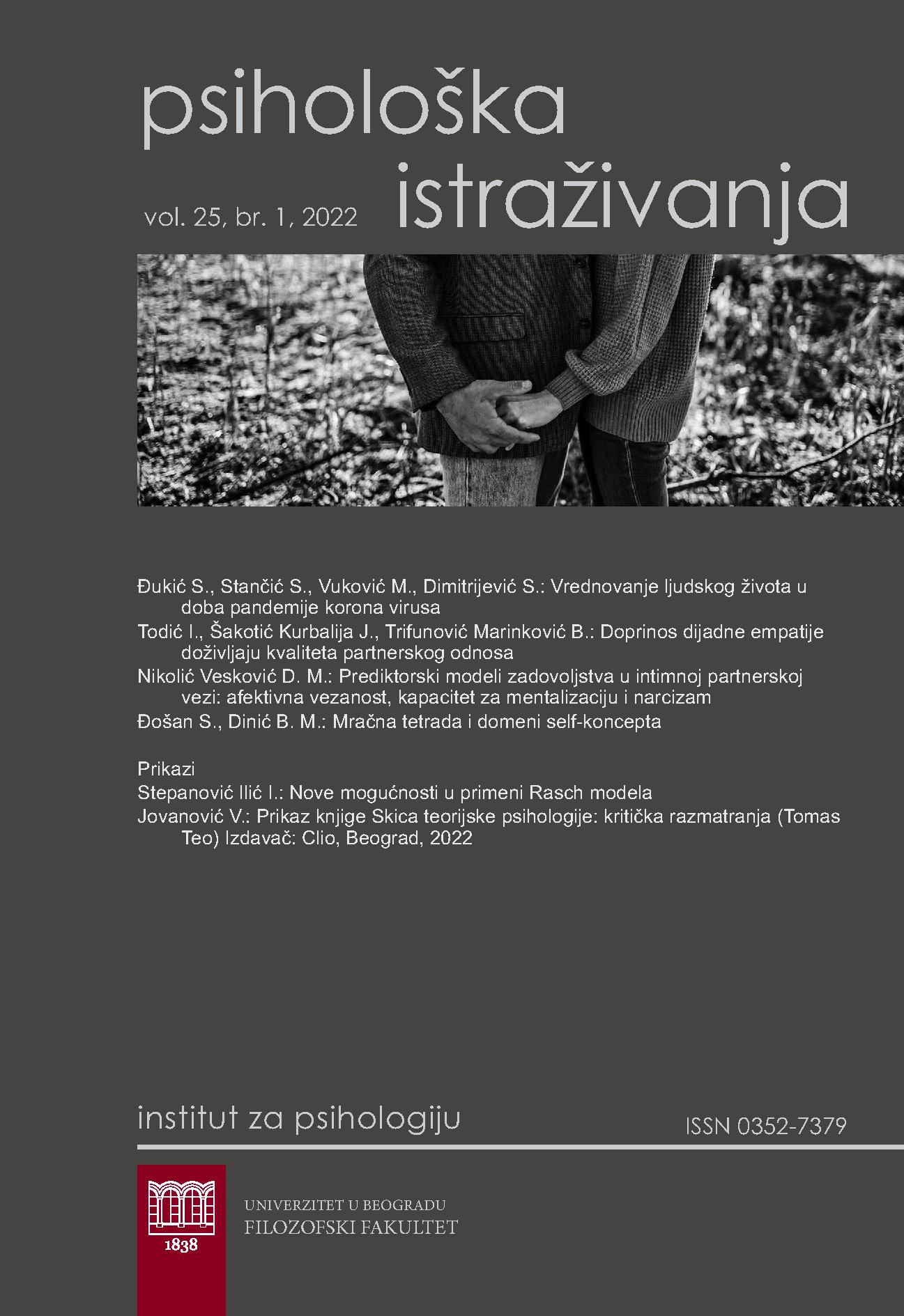
The aim of this research is to try to determine whether the introduction of mentalization and narcissism into the basic predictive model that contains the dimensions of affective attachment, anxiety and avoidance, improves the prediction of satisfaction in intimate partnerships. The survey involved 222 respondents aged 18 to 50 who are childless, in an intimate partnership or marriage, for a minimum of one and a maximum of ten years. Respondents completed questionnaires in electronic form, namely: SM-ECR-R for affective attachment assessment, UM, mentalization test questionnaire, NPI40 for narcissism level assessment and RAS scale for intimacy satisfaction assessment. The results show that the basic model is a significant predictor of satisfaction in an intimate partnership, with low anxiety and low avoidance predicting greater satisfaction. By introducing narcissism and the mentalization of others into the basic predictive model in particular, the predictive power of the model is improved, with the mentalization of others contributing more to the improvement of the basic model than narcissism. A higher level of narcissism and a higher level of mentality of others predict lower satisfaction in an intimate partnership. When the mentalization of others and narcissism are introduced into the basic model at the same time, the predictive power of the model does not increase significantly in relation to the basic model to which only the mentalization of others is added. The conclusion of the research is that the mentalization of others contributes most to the improvement of the predictive power of the basic model.
Keywords
Authors retain the copyright of the published papers and grant to the publisher the nonexclusive right to publish the article, to be cited as its original publisher in case of re-use, and to distribute it in all forms and media. The published articles will be distributed under the Creative Commons Attribution ShareAlike 4.0 International license (CC BY-SA). It is allowed to copy and redistribute the material in any medium or format, and remix, transform and build upon it for any purpose, even commercially, as long as appropriate credit is given to the original
author(s), a link to the license is provided, it is indicated if changes were made and the new work is distributed under the same license as the original. Authors are permitted to deposit the author’s publisher’s version (PDF) of their work in an institutional repository, subject-based repository, author’s personal website (including social networking sites, such as ResearchGate, Academia.edu, etc.), and/or departmental website at any time after publication, with an acknowledgment of its initial publication in this journal.