

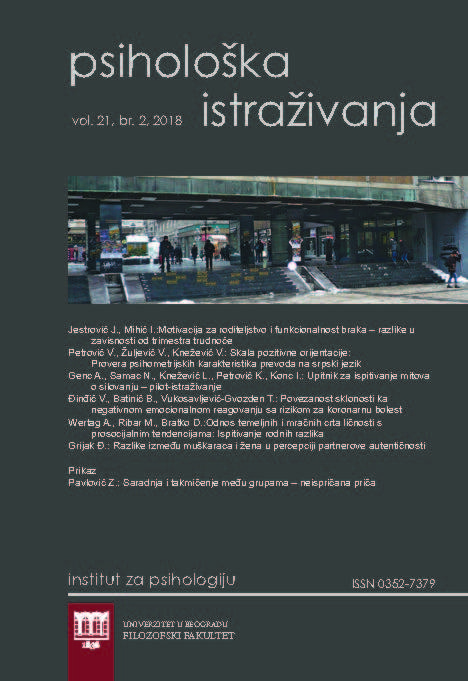
Kako citirati
Sažetak
Cilj: Primarni cilj ovog istraživanja je bio da se ispita povezanost sklonosti ka negativnom emocionalnom reagovanju operacionalizovane kroz crte depresivnosti, anksioznosti i besa sa rizikom za nastanak koronarne bolesti. Drugi cilj se odnosi na izdvajanje linearne kombinacije crta koja najbolje razlikuju osobe različitog zdravstvenog statusa u kontekstu koronarne bolesti. Metod: Istraživanje se prema metodologiji svrstava u istraživanja korelacionog, neeksperimentalnog tipa. Uzorak istraživanja činilo je 150 ispitanika koji su podeljeni u tri grupe. U prvoj grupi su osobe koje imaju dijagnozu koronarne bolesti, u drugoj osobe koje nemaju dijagnozu koronarne bolesti ali se nalaze pod specifičnim rizikom za koronarnu bolest i u trećoj grupi su osobe bez dijagnoze koronarne bolesti i bez specifičnog rizika za razvoj koronarne bolesti. Korišćeni su sledeći instrumenti: Skala Depresivne Ličnosti, Spilbergerov upitnik anksioznosti i Spilbergerov upitnik ekspresije besa. Rezultati: Osobe sa dijagnozom koronarne bolesti su na svim instrumentima imale više skorove nego osobe koje nisu imale dijagnozu koronarne bolesti i koje nisu imale faktore rizika. Osobe sa specifičnim rizikom za koronarnu bolest su imale više skorove od osoba koje nisu imale dijagnozu koronarne bolesti i faktore rizika na skalama koje mere crtu anksioznosti i crtu besa. Diskriminacionom analizom dobijeno je da crta anksioznosti najbolje razlikuje tri grupe ispitanika. Crte depresivnosti i besa su se pokazale kao redundantne u odnosu na predikciju. Zaključci: Dobijeni rezultati ukazuju na postojanje povezanosti crta anksioznosti, besa i depresivnosti sa rizikom za koronarnu bolest. Diskriminaciona analiza je pokazala da se crta anksioznosti izdvojila kao jedini pouzdan prediktor.
Ključne reči
||tendencija ka negativnom emocionalnom reagovanju
risk||
||rizik
heart diseases||
||bolesti srca
heart||
||srce
emotions||
||emocije
depression||
||depresija
anger||
||bes
anxiety||
||anksioznost
Reference
Appels, A., Bär, F.W., Bär, J., Bruggeman, C., & de Baets, (. (2000). Inflammation, Depressive Symptomatology, and Coronary Artery Disease. Psychosomatic Medicine, 62(5), 601-605. doi:10.1097/00006842-200009000-00001
Bonnet, F., Irving, K., Terra, J., Nony, P., Berthezène, F., & Moulin, P. (2005). Anxiety and depression are associated with unhealthy lifestyle in patients at risk of cardiovascular disease. Atherosclerosis, 178(2), 339-344. doi:10.1016/j.atherosclerosis.2004.08.035
Camatta, C.D., & Nagoshi, C.T. (1995). Stress, Depression, Irrational Beliefs, and Alcohol Use and Problems in a College Student Sample. Alcoholism: Clinical and Experimental Research, 19(1), 142-146. doi:10.1111/j.1530-0277.1995.tb01482.x
Castillo, M.I., Cooke, M.L., Macfarlane, B., & Aitken, L.M. (2016). Trait Anxiety But Not State Anxiety During Critical Illness Was Associated With Anxiety and Depression Over 6 Months After ICU. Critical Care Medicine, 44(1), 100-110. doi:10.1097/ccm.0000000000001356
Chida, Y., & Steptoe, A. (2009). The association of anger and hostility with future coronary heart disease: a meta-analytic review of prospective evidence. Journal of the American College of Cardiology, 53(11), 936-946. doi:10.1016/j.jacc.2008.11.044
Davidson, K.W., & Mostofsky, E. (2010). Anger expression and risk of coronary heart disease: Evidence from the Nova Scotia Health Survey. American Heart Journal, 159(2), 199-206. doi:10.1016/j.ahj.2009.11.007
Denollet, J. (2005). DS14: Standard Assessment of Negative Affectivity, Social Inhibition, and Type D Personality. Psychosomatic Medicine, 67(1), 89-97. doi:10.1097/01.psy.0000149256.81953.49
Denollet, J., Pedersen, S.S., Vrints, C.J., & Conraads, V.M. (2006). Usefulness of Type D Personality in Predicting Five-Year Cardiac Events Above and Beyond Concurrent Symptoms of Stress in Patients With Coronary Heart Disease. The American Journal of Cardiology, 97(7), 970-973. doi:10.1016/j.amjcard.2005.10.035
Denollet, J., Rombouts, H., Gillebert, T., Brutsaert, D., Sys, S., Brutsaert, D., & Stroobant, N. (1996). Personality as independent predictor of long-term mortality in patients with coronary heart disease. The Lancet, 347(8999), 417-421. doi:10.1016/s0140-6736(96)90007-0
Friedman, M., & Rosenman, R.H. (1959). Association of specific overt behavior pattern with blood and cardiovascular findings: blood cholesterol level, blood clotting time, incidence of arcus senilis, and clinical coronary artery disease. Journal of the American Medical Association, 169(12), doi:10.1001/jama.1959.03000290012005
Gallo, L.C., Ghaed, S.G., & Bracken, W.S. (2004). Emotions and Cognitions in Coronary Heart Disease: Risk, Resilience, and Social Context. Cognitive Therapy and Research, 28(5), 669-694. doi:10.1023/b:cotr.0000045571.11566.19
Institut za javno zdravlje Srbije ,,Dr Milan Jovanović Batut”. (2015). Incidencija i mortalitet od akutnog koronarnog sindroma u Srbiji. http://www.batut.org.rs/download/publikacije/2014AkutniKoronarniSindrom.pdf.
Katiyar, M., Gupta, S.C., & Singh, H. (1989). Role of neuroticism and extraversion in patients of acute myocardial infraction. Indian J Clin Psychol, 15, 18-20.
Kawachi, I., Colditz, G.A., Ascherio, A., Rimm, E.B., Giovannucci, E., Stampfer, M.J., & Willett, W.C. (1994). Prospective study of phobic anxiety and risk of coronary heart disease in men. Circulation, 89(5), 1992-1997. doi:10.1161/01.cir.89.5.1992
Kawachi, I., Sparrow, D., Spiro, A., Vokonas, P., & Weiss, S.T. (1996). A prospective study of anger and coronary heart disease: The Normative Aging Study. Circulation, 94(9), 2090-2095. doi:10.1161/01.cir.94.9.2090
Khan, A.A., Hassan, M., Kumar, P., Mishra, D., & Kumar, R. (2012). Personality Profile and Coping Skills among Coronary Heart Disease Patients and Non-Patient Groups. Delhi Psychiatry Journal, 15(2), 352-358.
Knaus, W.J. (1983). How To Conquer Your Frustrations. New Jersey: Prentice Hall Trade.
Kubzansky, L.D., Cole, S.R., Kawachi, I., Vokonas, P., & Sparrow, D. (2006). Shared and unique contributions of anger, anxiety, and depression to coronary heart disease: A prospective study in the normative aging study. Annals of Behavioral Medicine, 31(1), 21-29. doi:10.1207/s15324796abm3101_5
Marić, Z. (2002). Kognitivni činioci emocije i emocionalnog poremećaja iz ugla REBT. Beograd: Filozofski fakultet. Magistarski rad.
Eng, P.M., Fitzmaurice, G., Kubzansky, L.D., Rimm, E.B., & Kawachi, I. (2003). Anger Expression and Risk of Stroke and Coronary Heart Disease Among Male Health Professionals. Psychosomatic Medicine, 65(1), 100-110. doi:10.1097/01.psy.0000040949.22044.c6
Mook, J., Van, D.P.H.M., & Chr. Kleijn, W. (1990). Anxiety, anger and depression: Relationships at the trait level. Anxiety Research, 3(1), 17-31. doi:10.1080/08917779008248738
Myrtek, M. (2001). Meta-analyses of prospective studies on coronary heart disease, type A personality, and hostility. International Journal of Cardiology, 79(2-3), 245-251. doi:10.1016/s0167-5273(01)00441-7
Nekouei, Z.K., Yousefy, A., Doost, H.T., Manshaee, G., & Sadeghei, M. (2014). Structural Model of psychological risk and protective factors affecting on quality of life in patients with coronary heart disease: A psychocardiology model. Journal of research in medical sciences: The official journal of Isfahan University of Medical Sciences, 19(2), 90.
Novović, Z., Mihić, (., & Tovilović, S. (2010). Procena depresivnog poremećaja ličnosti. U M. Biro, S. Smederevac, & Z. Novović (Ur.), Procena psiholoških i psihopatoloških fenomena. Beograd: CPP.
Papageorgiou, C., Panagiotakos, D.B., Pitsavos, C., Tsetsekou, E., Kontoangelos, K., Stefanadis, C., & Soldatos, C. (2006). Association between plasma inflammatory markers and irrational beliefs; the ATTICA epidemiological study. Progress in Neuro-Psychopharmacology and Biological Psychiatry, 30(8), 1496-1503. doi:10.1016/j.pnpbp.2006.05.018
Player, M.S., & Peterson, L.E. (2011). Anxiety Disorders, Hypertension, and Cardiovascular Risk: A Review. The International Journal of Psychiatry in Medicine, 41(4), 365-377. doi:10.2190/pm.41.4.f
Puterman, E., Epel, E.S., O’Donovan, A., Prather, A.A., Aschbacher, K., & Dhabhar, F.S. (2014). Anger Is Associated with Increased IL-6 Stress Reactivity in Women, But Only Among Those Low in Social Support. International Journal of Behavioral Medicine, 21(6), 936-945. doi:10.1007/s12529-013-9368-0
Rozanski, A., Blumenthal, J.A., & Kaplan, J. (1999). Impact of Psychological Factors on the Pathogenesis of Cardiovascular Disease and Implications for Therapy. Circulation, 99(16), 2192-2217. doi:10.1161/01.cir.99.16.2192
Rugulies, R. (2002). Depression as a predictor for coronary heart disease: a review and meta-analysis. American Journal of Preventive Medicine, 23(1), 51-61. doi:10.1016/s0749-3797(02)00439-7
Sirois, B.C., & Burg, M.M. (2003). Negative emotion and coronary heart disease: A review. Behavior Modification, 27(1), 83-102. doi:10.1177/0145445502238695
Smith, P.J., & Blumenthal, J.A. (2011). Psychiatric and Behavioral Aspects of Cardiovascular Disease: Epidemiology, Mechanisms, and Treatment. Revista Española de Cardiología (English Edition), 64(10), 924-933. doi:10.1016/j.rec.2011.06.003
Spielberger, C.D. (1983). Manual for the State-Trait Anxiety Inventory (Form Y). Palo Alto, CA: Mind Garden.
Spielberger, C.D. (1999). State-trait anger expression inventory-2: Professional manual. Odessa, Fla.: Psychological Assessment Resources, Inc..
Stanković, S., & Vukosavljević-Gvozden, T. (2011). The Relationship of a Measure of Frustration Intolerance with Emotional Dysfunction in a Student Sample. Journal of Rational-Emotive and Cognitive-Behavior Therapy, 29(1), 17-34. doi:10.1007/s10942-011-0128-2
Steptoe, A., & Molloy, G.J. (2007). Personality and heart disease. Heart, 93(7), 783-784. doi:10.1136/hrt.2006.109355
Vasan, R.S., Larson, M.G., Leip, E.P., Kannel, W.B., & Levy, D. (2001). Assessment of frequency of progression to hypertension in non-hypertensive participants in the Framingham Heart Study: a cohort study. The Lancet, 358(9294), 1682-1686. doi:10.1016/s0140-6736(01)06710-1
Vasiljević, Z. (2011). Akutni koronarni sindrom. U: M. Ostojić, V. Kanjuh, & B. Beleslin (Ur.), Kardiologija. 424-462.
von Känel, R., Mills, P.J., Fainman, C., & Dimsdale, J.E. (2001). Effects of Psychological Stress and Psychiatric Disorders on Blood Coagulation and Fibrinolysis: A Biobehavioral Pathway to Coronary Artery Disease. Psychosomatic Medicine, 63(4), 531-544. doi:10.1097/00006842-200107000-00003
Williams, J.E., Paton, C.C., Siegler, I.C., Eigenbrodt, M.L., Nieto, F.J., & Tyroler, H.A. (2000). Anger proneness predicts coronary heart disease risk: prospective analysis from the Atherosclerosis Risk in Communities (ARIC) study. Circulation, 101(17), 2034-2039. doi:10.1161/01.cir.101.17.2034
World Health Organization. (1992). International statistical classification of diseases and related health problems. Geneva: WHO. 10th revision.
Poirier, P., Giles, T.D., & Bray, G.A. (2006). Obesity and cardiovascular disease. Circulatio, 113, 898-918.
Kannel, W.B., Dawber, T.R., Kagan, A., Revotskie, N., & Stokes, J. (1961). Factors of risk in the development of coronary heart disease -- six-year follow-up experience: the Framingham Study. Annals of Internal Medicine, 55, 33-50.
Phillips, A.C., Batty, G.D., Gale, C.R., Deary, I.J., Osborn, D., & MacIntyre, K. (2009). Generalized anxiety disorder, major depressive disorder, and their comorbidity as predictors of all-cause and cardiovascular mortality: the Vietnam experience study. Psychosomatic Medicine, 71, 395-403.
Autori zadržavaju autorska prava nad objavljenim člancima, a izdavaču daju neekskluzivno pravo da članak objavi, da u slučaju daljeg korišćenja članka bude naveden kao njegov prvi izdavač, kao i da distribuira članak u svim oblicima i medijima. Objavljeni članci distribuiraju se u skladu sa licencom Creative Commons Autorstvo – Deliti pod istim uslovima 4.0 International (CC BY-SA) . Dopušteno je da se delo kopira i distribuira u svim medijima i formatima, da se prerađuje, menja i nadograđuje u bilo koje svrhe, uključujući i komercijalne, pod uslovom da se na pravilan način citiraju njegovi prvobitni autori, postavi link ka originalnoj licenci, naznači da li je delo izmenjeno i da se novo delo objavi pod istom licencom kao i
originalno. Autorima je dozvoljeno da objavljenu verziju rada deponuju u institucionalni ili tematski repozitorijum ili da je objave na ličnim veb stranicama (uključujući i profile na društvenim mrežama, kao što su ResearchGate, Academia.edu, itd.), na sajtu institucije u kojoj su zaposleni, u bilo koje vreme nakon objavljivanja u časopisu, uz adekvatno referisanje.